
Brain Simulation Software

BrainX — our in-house open-source brain-simulation ecosystem, spanning ion channels to whole-brain networks, with native heterogeneous-hardware support and a clear path to hundred-billion-neuron whole-brain dynamics.

BrainX: a software ecosystem for whole-brain dynamics simulation

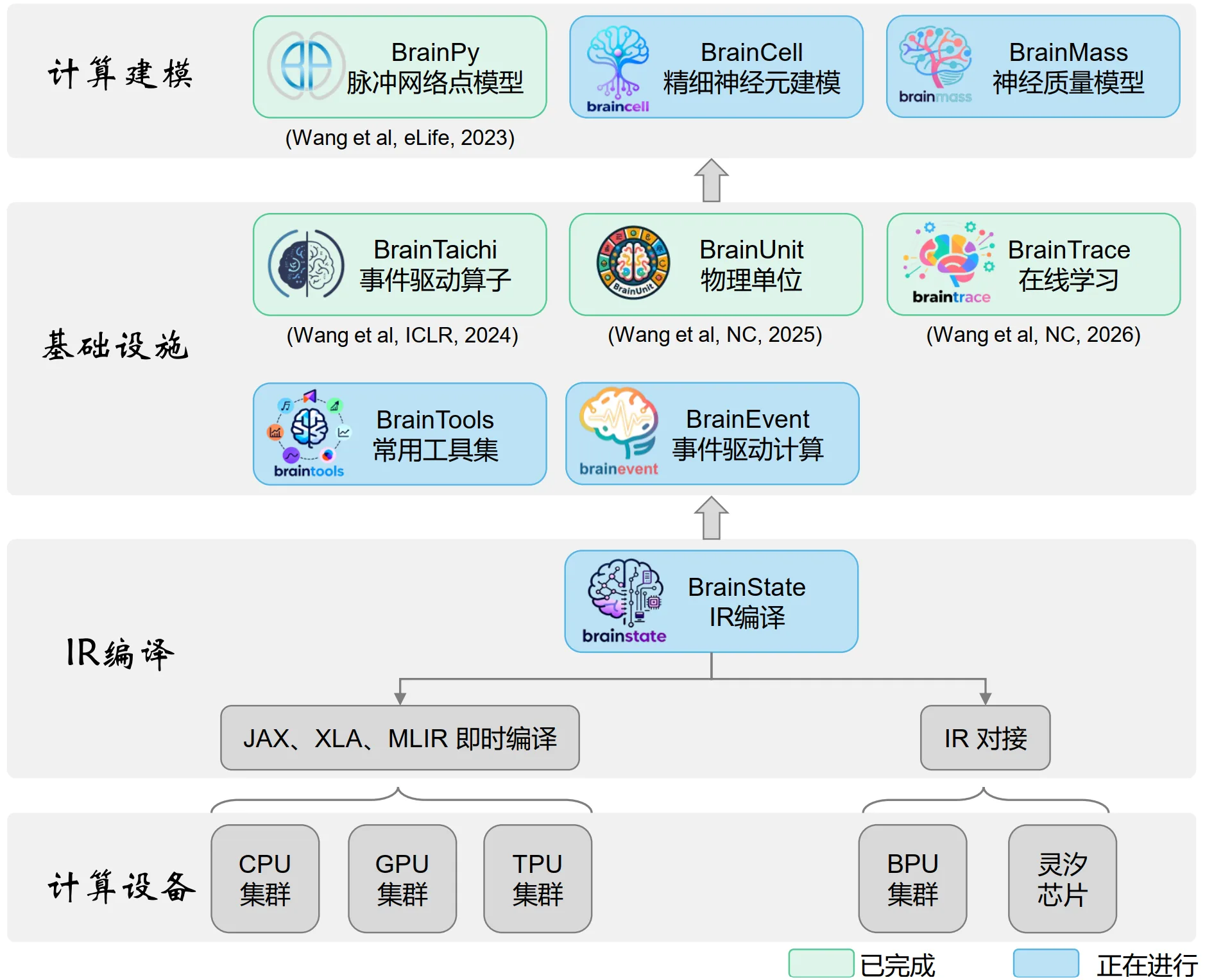
BrainX is our open-source brain-simulation ecosystem, spanning multi-scale modeling from ion channels and single cells to circuits and whole-brain networks. It brings modern AI compilation (JAX/XLA) into computational neuroscience, giving brain-dynamics simulation native support for CPU/GPU/TPU and heterogeneous accelerators, seamless interoperability with the deep-learning ecosystem, and a clear path toward whole-brain dynamics at hundred-billion-neuron scale.

BrainX: a software ecosystem for whole-brain dynamics simulation

BrainX module matrix

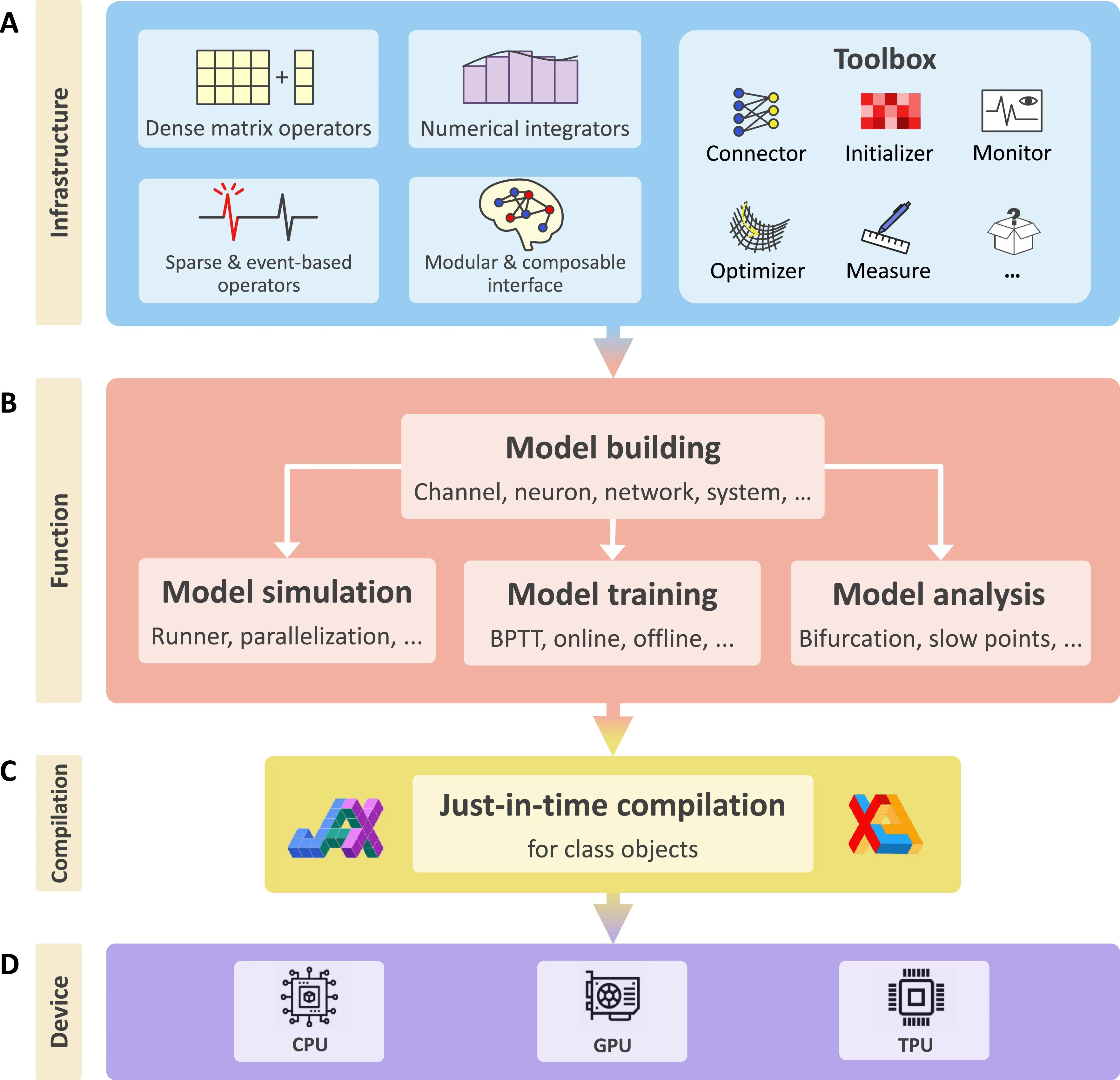
BrainX is composed by layer of responsibility: a runtime and numerics foundation at the bottom, event computing and multi-scale modeling in the middle, with learning algorithms and toolkits above. Each layer is independently usable and designed to compose.

1. BrainPy: a general framework for brain-dynamics modeling

BrainPy

BrainPy is the core general-purpose brain-dynamics modeling framework in the BrainX ecosystem, providing a unified abstraction from scientific models to executable simulations. Rather than serving only as a model library, it organizes neurons, synapses, networks, neural-mass models, learning rules, and experimental workflows as composable, differentiable, and compilable objects, so models across scales and paradigms can be expressed, trained, and reproduced through one interface. Its key innovation is the integration of mechanistic computational-neuroscience modeling with a modern AI compilation stack: built on JAX/XLA, BrainPy brings JIT compilation, automatic differentiation, vectorization, and heterogeneous acceleration to neural dynamics, enabling high-performance simulation, parameter learning, and task-driven optimization for large-scale brain simulation and brain-inspired intelligence. The four items below briefly trace BrainPy through its framework paper, differentiable brain-simulation work, JIT compilation method, and practical book, showing its development from compilation foundations and system design to differentiable simulation and educational practice.
2021 ICONIP

A just-in-time compilation approach for neural dynamics simulation

Chaoming Wang, Yingqian Jiang, Xinyu Liu et al.

This paper focuses on how JIT compilation can be applied to neural-dynamics simulation, converting model equations into efficient executable procedures that reduce interpreter overhead and improve batched simulation. It lays a low-level technical foundation for BrainPy's later compiled execution, automatic differentiation, and heterogeneous hardware acceleration.

2023 eLife

BrainPy, a flexible, integrative, efficient, and extensible framework for general-purpose brain dynamics programming

Chaoming Wang, Tianqiu Zhang, Xiaoyu Chen et al.

As BrainPy's system-level framework paper, this work introduces a unified programming abstraction for brain dynamics: neurons, synapses, networks, neural-mass models, and differential-equation systems are organized as composable objects with JIT compilation, automatic differentiation, and vectorized execution built in. Its value is not only faster simulation, but also a reproducible software workflow for models across scales and paradigms.

2023 Publishing House of Electronics Industry

Neural Computation Modeling in Practice: with BrainPy

Chaoming Wang, Xiaoyu Chen, Tianqiu Zhang et al.

This book turns BrainPy's framework ideas into a progressive hands-on path, from building neurons, synapses, and networks to learning rules, experiment reproduction, and simulation analysis. It serves as the practical and educational bridge that helps readers apply BrainPy's abstractions to runnable modeling tasks.

2024 ICLR

A differentiable brain simulator bridging brain simulation and brain-inspired computing

Chaoming Wang, Tianqiu Zhang, Sichao He et al.

This research advances BrainPy from a high-performance simulation framework into a differentiable brain-simulation platform, allowing neural-dynamics models to participate in gradient optimization, task training, and data fitting. Parameters, initial states, loss functions, and observations are unified in one trainable computation graph, giving brain simulation a closed loop for learning and optimization.

2. BrainUnit: unit-aware scientific computing infrastructure

BrainUnit BrainUnit

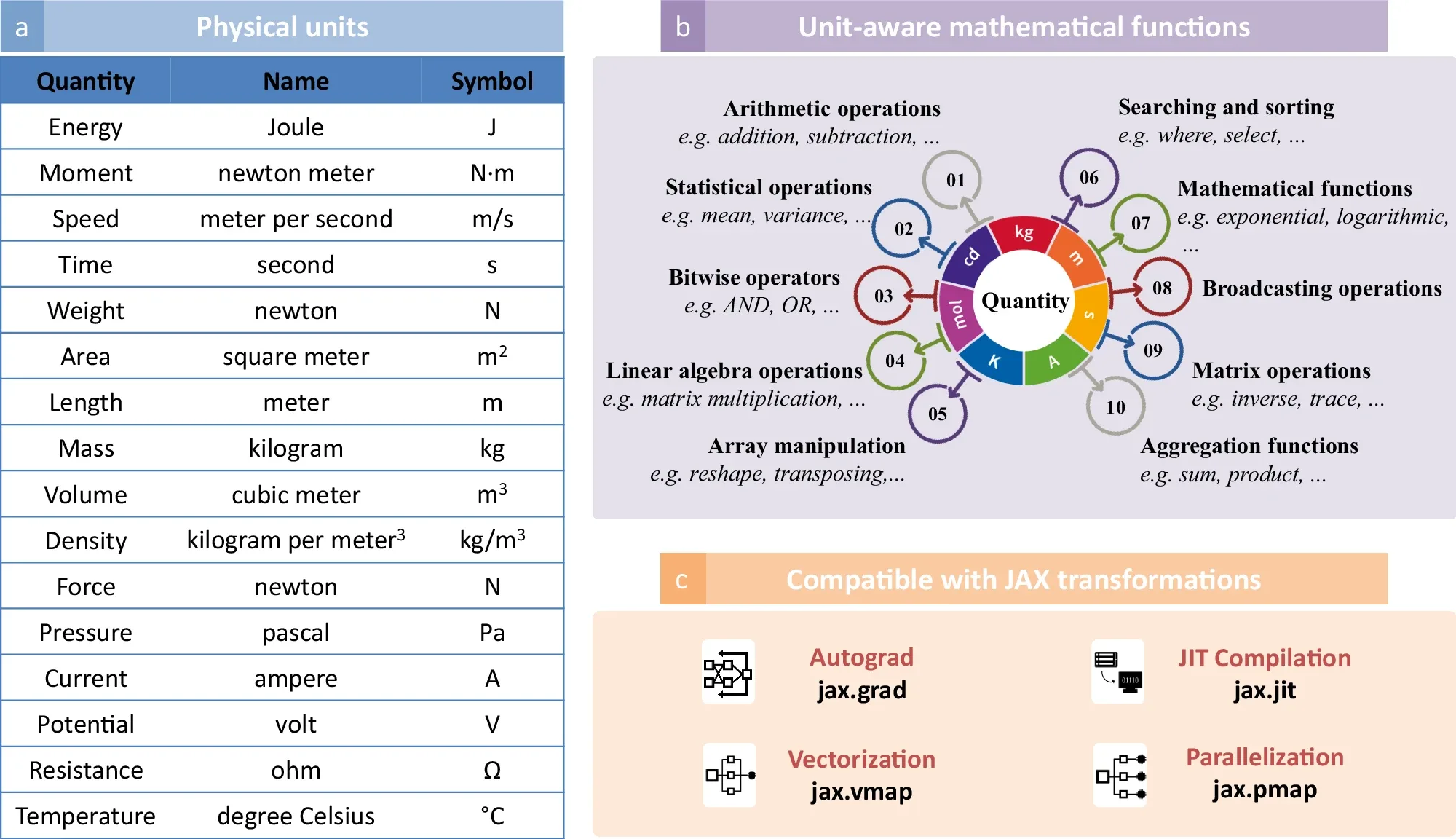
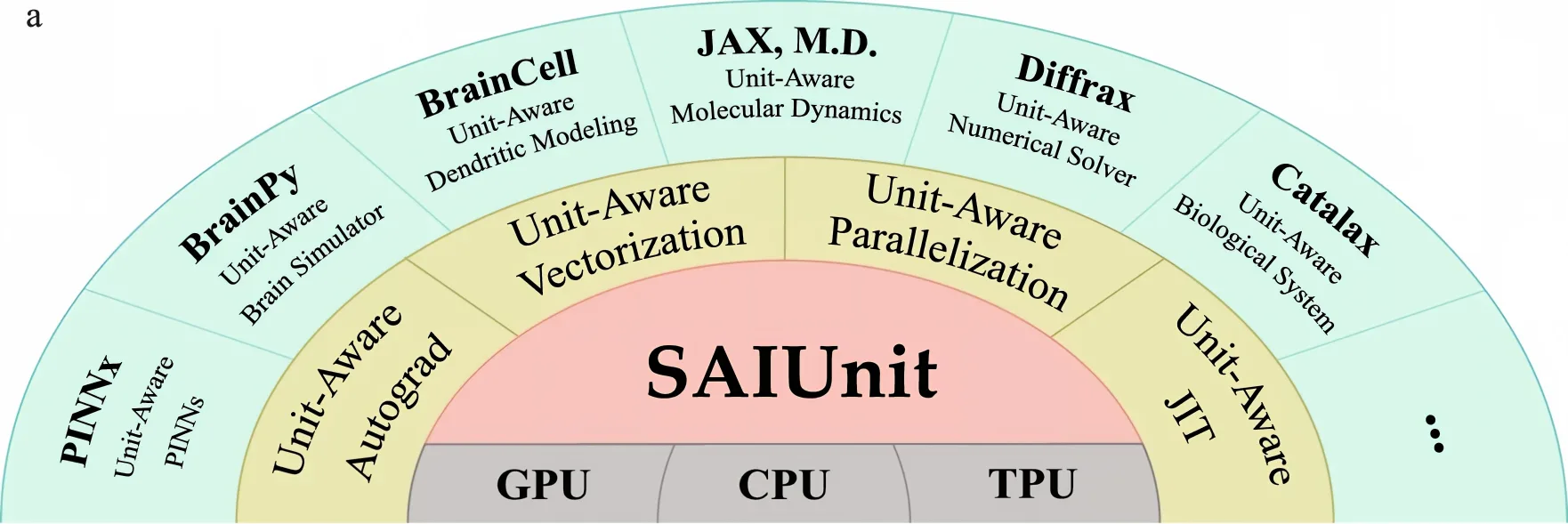
BrainUnit is the unit-aware scientific-computing engine in the BrainX ecosystem, built for variables, parameters, and equations that carry physical dimensions in brain-dynamics models. It embeds physical units into array operations, mathematical functions, automatic differentiation, and JIT compilation, keeping ion channels, electrophysiological variables, time constants, and synaptic parameters dimensionally consistent during high-performance execution and providing a reliable numerical basis for reproducible, composable multi-scale simulation. In practice, BrainUnit catches unit errors earlier in model construction and compilation, reducing hidden numerical risks when models are composed across scales and making scientific code closer to the original physical semantics.

Nature Communications 2025
Integrating physical units into high-performance AI-driven scientific computing Chaoming Wang, Sichao He, Shouwei Luo et al.Nature Communications 16, 3609, 2025

3. BrainTrace: online-learning compiler for brain dynamics

BrainTrace

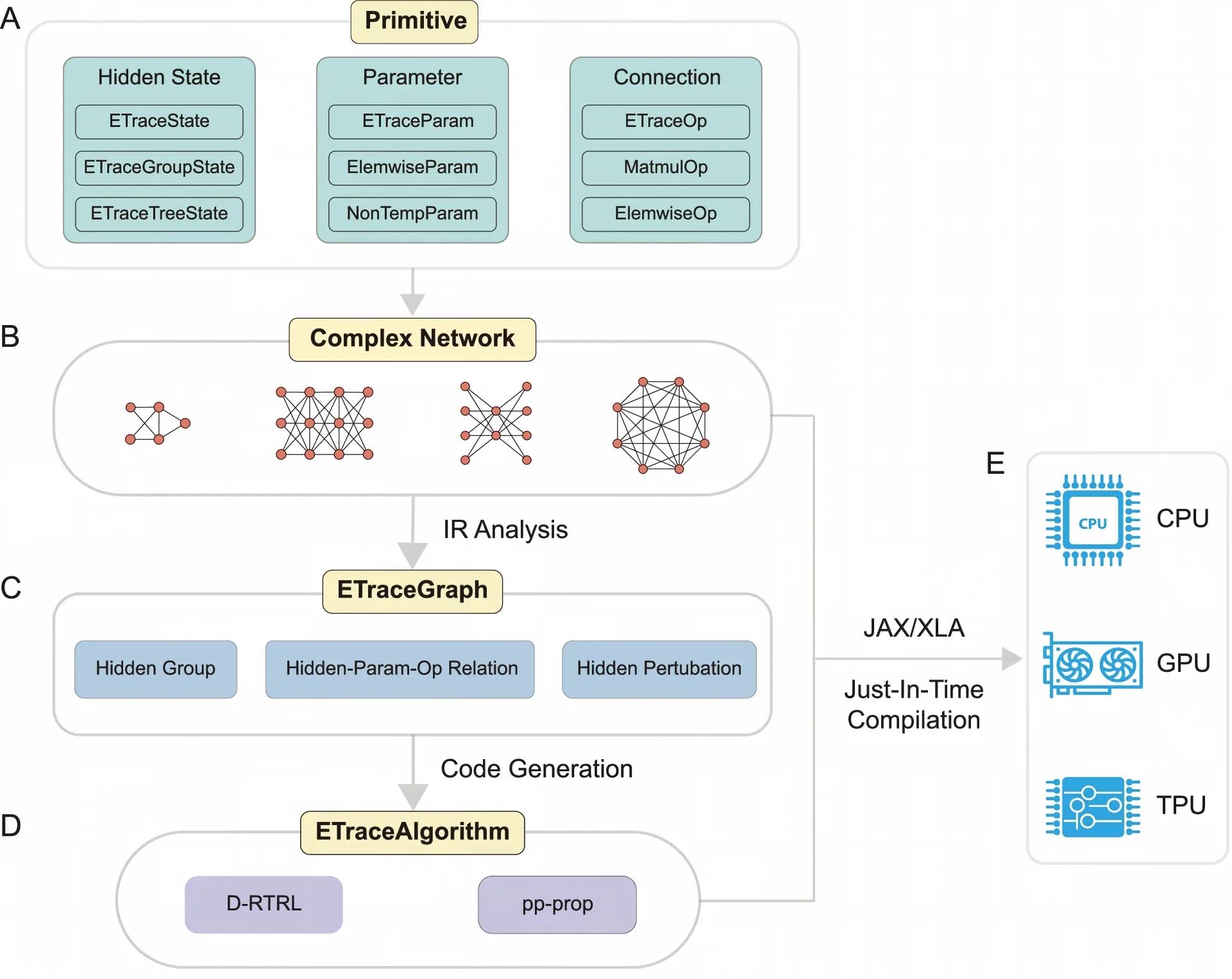
BrainTrace is the online-learning module in the BrainX ecosystem, designed for learning problems that unfold over time in large-scale spiking neural networks. It compiles eligibility-trace mechanisms into a model-agnostic, linear-memory online-learning workflow, enabling biologically plausible local learning rules to run across different SNN models, long sequences, and large network scales. By organizing state evolution, gradient propagation, and local plasticity signals as compilable processes, BrainTrace reduces reliance on fully unrolled temporal computation graphs and provides a unified interface for online adaptation, continual learning, and neuromorphic algorithm validation.

Nature Communications 2026
Model-agnostic linear-memory online learning in spiking neural networks Chaoming Wang, Xingsi Dong, Zilong Ji et al.Nature Communications 17, 1745, 2026