Brain Simulation Algorithms
Whole-brain simulation must simultaneously satisfy four goals often taken to be in tension: biological realism, computational efficiency, interpretability, and learning capacity. This track presents the algorithm system we develop to reconcile them, anchored by two representative results.
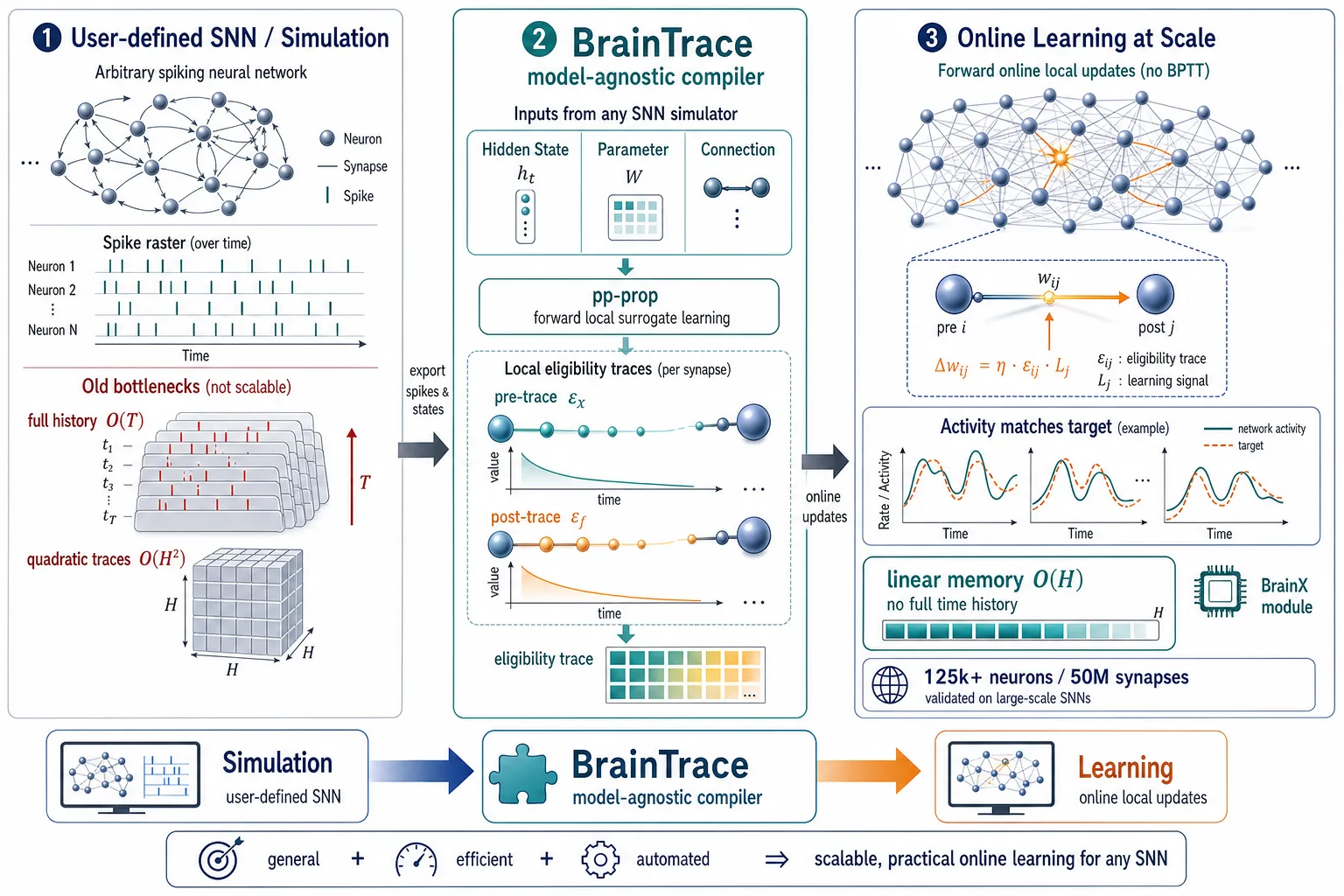
1. Model‑agnostic, linear‑memory online learning algorithm for spiking neural networks
Online learning in spiking neural networks (SNNs) has long been bottlenecked by memory cost that scales linearly with simulation time. BrainTrace introduces a model-agnostic, eligibility-trace-based online learning algorithm that reduces memory to linear, and ships as a compiler that can be embedded in any SNN simulation. For the first time, biologically plausible local learning rules can run at large SNN scale — connecting the simulation and learning tracks of brain research. The algorithm is implemented as the BrainTrace module of the BrainX ecosystem.
- Nature Communications 2026
- Model-agnostic linear-memory online learning in spiking neural networks
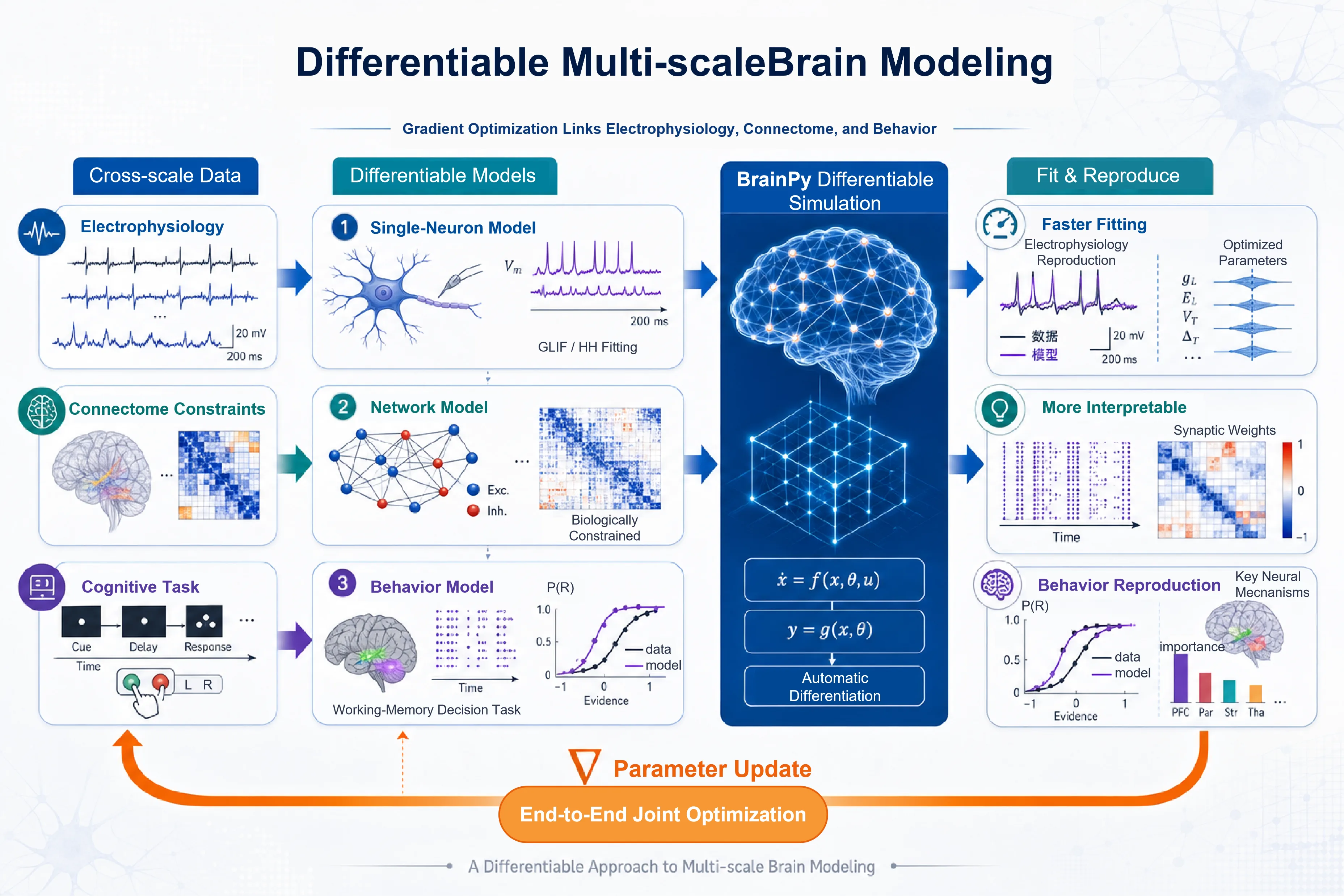
2. A differentiable approach to multi-scale brain modeling
Multi-scale brain models span cells, circuits, and regions, with a vast parameter space that frustrates conventional fitting. This work makes the entire multi-scale simulation differentiable, so models can be optimized end-to-end across scales via gradients — turning data → multi-scale model into a single learnable path and substantially improving fit to experimental data. The method is tightly coupled with the BrainX differentiable runtime, anchoring our differentiable-simulation stack.
- ICML 2024
- A Differentiable Approach to Multi-scale Brain Modeling